
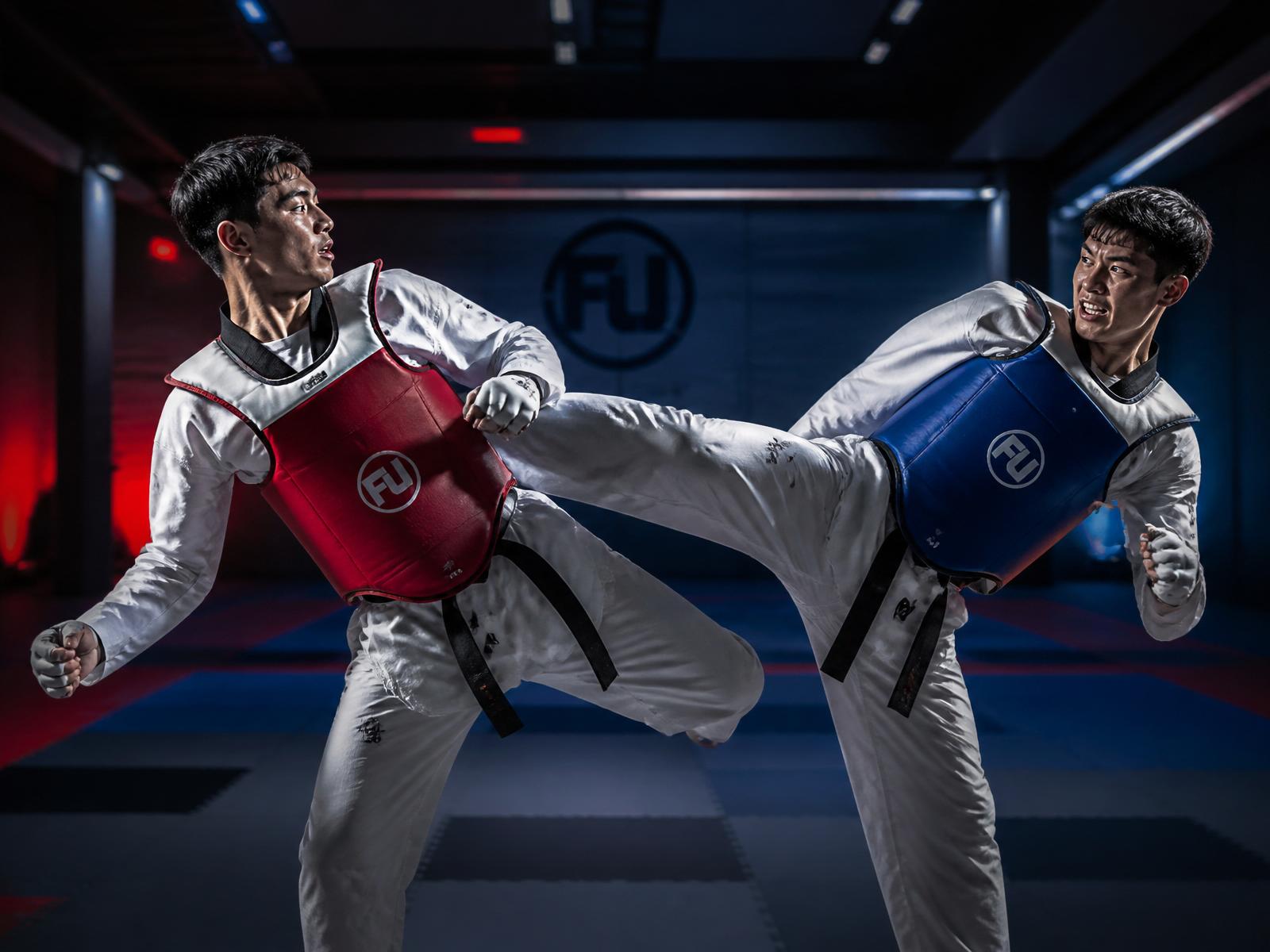
Any electronic hogu comparison should start with one question: do you need to referee official matches, or do you need to train fighters? Competition systems recognised by World Taekwondo, such as Daedo and KPNP, do the first job. A training protector such as FU FIGHT does the second. They are not rivals for the same task, and many clubs will meet both.
The role of recognised competition systems
In official taekwondo, the protector and scoring system (often called PSS) must be recognised by World Taekwondo. Daedo and KPNP are the two names every coach knows. Your fighters will meet one or the other at national and international events, depending on the organiser.
These systems are built to decide a result. That brings requirements:
- a full equipment chain: protectors, transmitters, receiver, software
- sensor socks for each fighter
- thresholds set by category
- operators at the table who know the software
- integration with judges' handsets and video replay
If your club or regional association hosts official competitions, there is no shortcut. You need a recognised system, whether you own it, hire it or use the one supplied by your federation.
The role of a training protector
A training protector answers a different need: giving feedback at every session, to as many members as possible, without turning the dojang into a competition hall.
FU FIGHT is a connected chest protector for training in clubs. Sensors detect valid hits and count the score automatically. The data is sent in real time to the coach and the athlete through a companion app. The coach can analyse precision, intensity and the split between punches and kicks, then adapt training.
It is a training system. It is not presented as recognised by World Taekwondo or by any federation for official competition.
Comparison table
| Criterion | Recognised competition system (Daedo, KPNP) | Training protector (FU FIGHT) |
|---|---|---|
| Main use | Refereeing official matches | Training in the club |
| Official recognition | Recognised by World Taekwondo | None claimed, training tool only |
| Budget level | Typically several thousand euros per court | 350 EUR per protector, two minimum |
| Equipment chain | Protectors, transmitters, receiver, software, socks | Protectors and a companion app |
| Setup | Needs trained operators | Ask for the demo videos to judge for yourself |
| Data for the coach | Match score, as designed for refereeing | Precision, intensity, punches versus kicks |
| Beginners and children | Built for competitors | Initiation version adjustable to level |
This table compares purposes, not quality. A competition system does its job well. It is simply a different job.
Three club profiles
The club that hosts official events
You need a recognised system. Talk to your federation about which brand is used in your country and whether equipment can be hired or shared between clubs. A training protector may still be useful on your other evenings, but it does not replace the recognised system.
The club with a competition squad that does not host
Your fighters need two things: familiarity with the system they will meet at tournaments, and a lot of scored repetitions. Some clubs buy a few competition protectors for this. Others travel to open training sessions where a recognised system is in use. A training protector covers the second need, which is weekly volume with feedback. Be honest with your fighters: each system has its own feel, so they still need time on the competition one before big events.
The club focused on juniors, beginners and leisure members
Here the question is motivation and learning, not refereeing. A training protector with an easy setting makes more sense than a competition setup. The FU FIGHT initiation version is designed to make learning more fun for beginners and children.
Questions to settle before you choose
- Will we host official competitions in the next two seasons?
- How many fighters need scored sparring each week?
- Who in the club will set up and run the equipment?
- Do we want data to guide training, or only a score?
- What can we afford this season, and next season?
If the answer to question 1 is yes, start with your federation. If it is no, a training system is the lighter route.
Background of the FU FIGHT technology
The technology comes from sport science research at Aix-Marseille University in France. The French Taekwondo Federation equipped itself with these connected protectors for the preparation of its athletes for the Paris 2024 Olympic Games. That is a preparation use, in training, which is exactly what the product is for.
FAQ
Can FU FIGHT replace Daedo or KPNP at a competition?
No. Official competitions require a system recognised by World Taekwondo. FU FIGHT is designed for training.
Will my fighters be ready for competition systems if they train with a training protector?
They will be used to clean contact, target areas and fighting with a live score. They should still get some sessions on the system used at their events, because each one behaves in its own way.
Which is cheaper?
A full competition setup represents a much larger budget, typically several thousand euros per court. A FU FIGHT protector costs 350 EUR, and you need at least two.
To compare with the facts in hand, request the free documentation pack and the full demo videos on the FU FIGHT site.
Ready to move to connected equipment?
Talk to our team about quotes, demos and partnerships.
Request a demo