
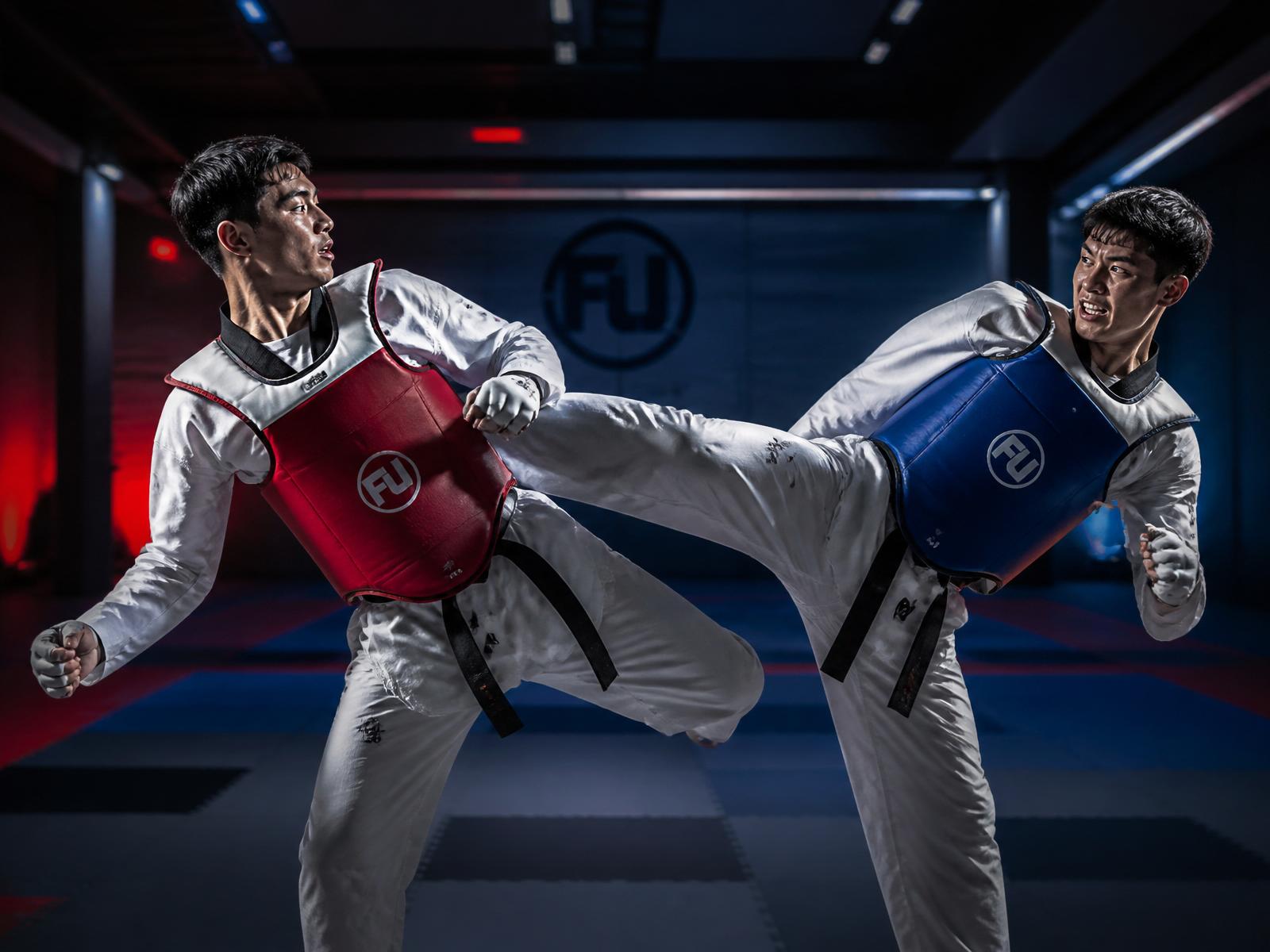
To organise a taekwondo tournament at club level, you need a clear format, enough protectors for your courts, a few trained volunteers and a schedule that respects children's attention. Electronic scoring makes a friendly event feel real and keeps arguments about points to a minimum. This checklist covers a club tournament or an interclub day, from the first email to the results sent to parents.
Why it is worth doing
- Experience for young fighters. A first competition among friends is far less stressful than a large open event. They learn to wait, warm up, bow in, fight with a score and lose well.
- Club life. Parents come, volunteers get involved, older members referee and coach the younger ones.
- Visibility. A well run day gives you photos, a story for the local paper and a reason to invite neighbouring clubs, schools or a sponsor.
One thing to state clearly from the start: this is a friendly, unofficial event. Official competitions require a scoring system recognised by World Taekwondo, such as Daedo or KPNP, and follow your federation's rules. If you use training protectors such as FU FIGHT, present the day as a training competition. Check with your national federation what a club may organise and what insurance and safeguarding rules apply.
Protectors and courts
The rule is simple: one court needs two scoring protectors, one per fighter.
| Courts | Protectors needed | Suits |
|---|---|---|
| 1 | 2 | Club tournament, up to about 20 fighters |
| 2 | 4 | Interclub day with two or three clubs |
| 3 | 6 | Larger interclub day |
Points to plan:
- Sizes. Check that your protectors fit the fighters entered.
- Score display. With FU FIGHT, the protector counts valid hits automatically and the app shows the score.
- A backup. Keep a paper score sheet and a stopwatch at each table in case of a technical problem.
Roles on the day
For each court:
- Centre referee. Starts and stops the bout, gives penalties, looks after safety. Choose your most experienced person. The equipment counts hits. It does not replace the referee.
- Table official. Runs the clock, follows the score, records the result.
- Coach. One per fighter, seated.
- Runner. Calls the next fighters and checks their gear.
For the whole event, add an organiser who does not referee, a first aider present all day, a welcome desk and someone for photos, with parents' consent sorted in advance.
A schedule that works
Short and tight is better than long and loose. Here is a half day model for about twenty children.
| Time | What happens |
|---|---|
| 0:00 | Arrival, registration, grouping |
| 0:30 | Briefing for fighters and parents, group warm-up |
| 0:50 | First bouts |
| 2:15 | Short break, demonstration by senior members |
| 2:30 | Final bouts |
| 3:10 | Medals or certificates for everyone, group photo |
| 3:30 | End |
Tips:
- Make small groups of three or four by age, size and level, and let everyone fight everyone in the group. Each child gets several bouts, whatever the result.
- Use short rounds for the youngest.
Safety, protective gear and briefing
Protective gear and contact rules
No compromise here, even among friends.
- Full protective gear as required by your federation for each age group: head guard, body protector, forearm and shin guards, gloves, foot protection, groin guard and mouthguard where required.
- Contact rules adapted to age and level, announced before the first bout. For beginners, many clubs limit or forbid head contact.
- Matched pairs. Never put a novice against an experienced fighter to fill a gap in the draw.
- Mats in good condition, a clear zone around each court, spectators kept back.
- A referee who stops the bout early when in doubt.
Briefing the fighters
Ten minutes before the first bout, with parents listening:
- How points are scored today. For example: kick to the trunk 2 points, turning kick to the trunk 4, penalty 1 point to the opponent. Say what applies to the head and to punches at your event.
- How the protector reacts. A clean kick on the target scores. A push or a slide does not.
- What the referee decides. Start, stop, penalties and safety.
- Behaviour. Bow, shake hands, thank the opposing coach.
For a full description of the scale, use the current official World Taekwondo rulebook as your reference, since rules change.
Sharing results with parents afterwards
The day is not over when the mats are stacked.
- Send a short message that evening: thanks, a group photo, the results by group.
- Give each child one positive point and one thing to work on. Parents remember that more than a medal.
FAQ
Can we run an official competition with training protectors?
No. Official competitions use systems recognised by World Taekwondo. Training protectors are suitable for friendly club events presented as such.
How many fighters can one court handle in a half day?
With short rounds and small groups, about twenty children is comfortable on one court.
What if the scoring fails during a bout?
Stop the bout, switch to the paper sheet and manual scoring by the referee and table, and carry on. Announce this backup plan in the briefing.
To plan your event with the right equipment, request the free documentation pack and the demo videos on the FU FIGHT site.
Ready to move to connected equipment?
Talk to our team about quotes, demos and partnerships.
Request a demo