
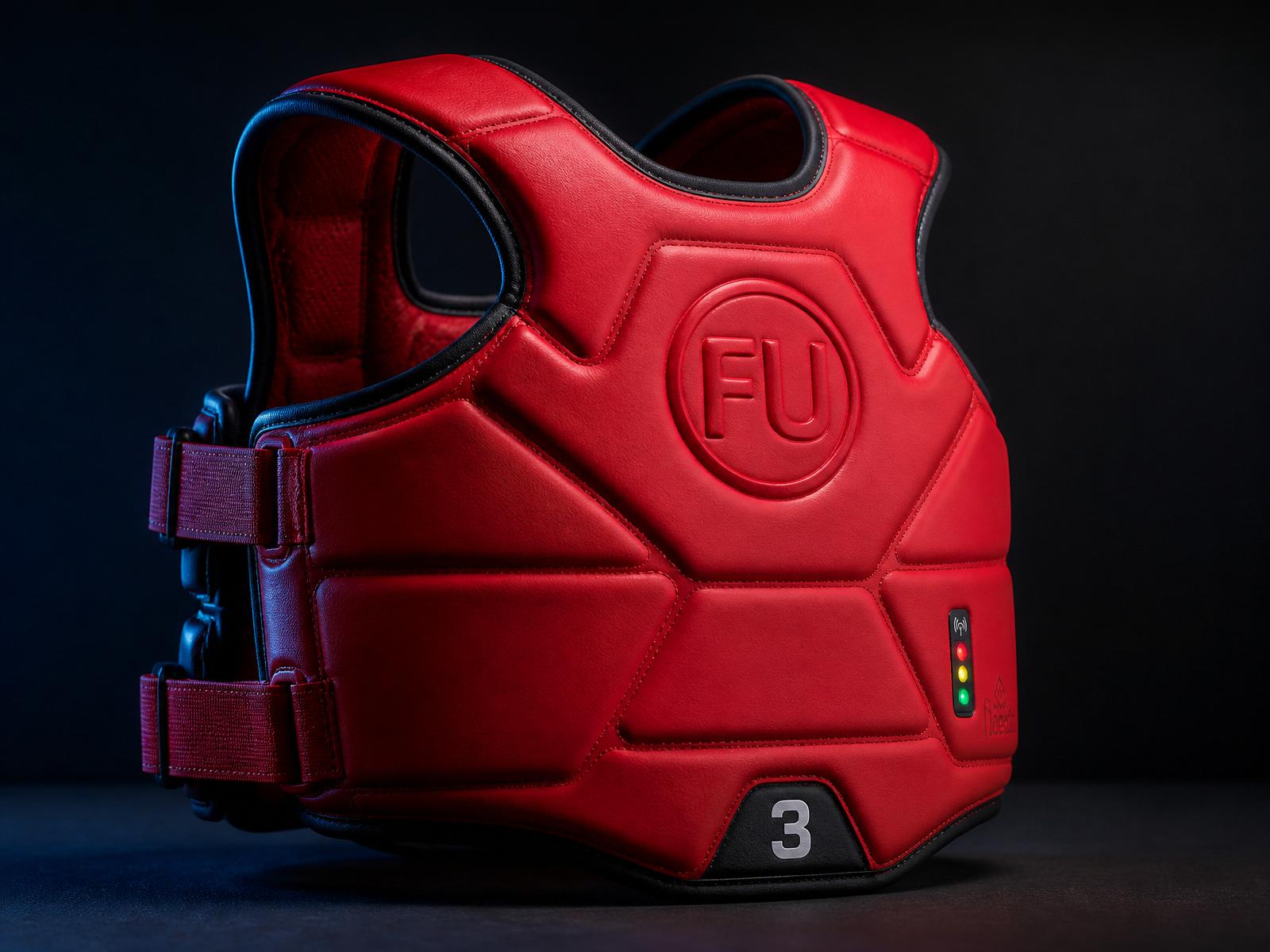
Taekwondo electronic scoring training means sparring and drilling with protectors that count the points, so your fighters learn what really scores before competition day. Fighters who only meet the system at tournaments lose points they thought they had earned. Here are the habits to build, five drills to run and a simple way to read the results.
Why fighters lose points on competition day
You have seen it from the coach's chair. Your fighter lands a kick, looks at the scoreboard, and nothing changes. Then doubt sets in and the game plan falls apart.
The usual causes:
- Contact that slides. The foot brushes the protector on the way past.
- Wrong part of the target. The kick lands on the edge, the hip or the arm.
- Not enough impact. Fast, light kicks that worked with human judges do not reach the threshold.
- Bad distance. Too close, the kick is smothered. Too far, only the toes arrive.
- Emotional reaction. The fighter stops to protest instead of following up.
None of this is solved by talking. It is solved by repetition with a score in front of the fighter.
Four habits to build
Clean contact
One clear impact on the target, then the foot comes back. Teach your fighters to "place and press" the kick, not to flick it.
Distance
Each fighter has one distance where their kick lands flat and strong. They need to find it, then learn to get there with a step, a switch or a slide.
Target areas
Work on hitting the scoring zone of the trunk from open and closed stance. Knowing where the kick should land is not the same as landing it there under pressure.
Pace
A scored round is not won in the first twenty seconds. Fighters must learn to score, protect the lead and score again when tired.
Five drills with scoring protectors
You need at least two protectors to spar. For drills 1 and 2, one is enough if the partner wears it.
Drill 1: ten clean kicks
The partner stands still with the protector on. The fighter throws ten single kicks from their own distance, with full reset between each. Count how many register. Change sides. The goal is a high success rate, not speed.
Drill 2: step in, score, step out
Same setup, but the fighter starts out of range. One step in, one kick, back out. Then the partner starts to move back or to the side on the kick. This links footwork to scoring.
Drill 3: first to three
Two fighters, both in protectors. The round stops when one reaches three points. Reset and go again, five times. Short rounds make every exchange count and expose who rushes.
Drill 4: protect or chase
Start the round with an imaginary score: one fighter leads by four with thirty seconds left. The leader must keep the lead without running out of the area. The other must catch up. Swap roles. This is the most common end of round situation, and few fighters practise it.
Drill 5: last round legs
Run a hard conditioning block first (kicks on pads, shuttle runs), then go straight into a scored round. Compare with a fresh round. Fighters see for themselves what fatigue does to their contact.
Reading the results after the session
With FU FIGHT, the score is counted automatically and the data goes to the coach and the athlete in real time through the app. The coach can analyse precision, intensity and the split between punches and kicks. Use those three views.
| What you look at | What it may tell you | What to adjust |
|---|---|---|
| Precision | Many kicks thrown, few valid | More work on drills 1 and 2 |
| Intensity | Drops in later rounds | Conditioning, pacing work (drill 5) |
| Punches versus kicks | Almost no punches | Add close range combinations |
Keep the debrief short. One point per fighter, one drill to fix it, and check again the following week.
A word on honesty with your squad
Each scoring system has its own feel. Official competitions use systems recognised by World Taekwondo, such as Daedo and KPNP. FU FIGHT is a training system. What it builds is general: clean contact, distance and calm under a live score. Before a major event, give your fighters some time on the system used at that event if you can. And check the current official rulebook, since rules and thresholds change.
FAQ
How often should we train with scoring protectors?
Once a week is a good start for a competition group. Use them for part of the session, not all of it, so technique work and free sparring keep their place.
Should beginners use them too?
Yes, with an easier setting. FU FIGHT has an initiation version adjustable to the level of the practitioner, designed for beginners and children.
My fighter kicks hard but does not score. Why?
Most often it is the contact or the target, not the force. Go back to static kicks at the right distance and watch where and how the foot lands.
To see these sessions in practice, request the free documentation pack and the demo videos on the FU FIGHT site.
Ready to move to connected equipment?
Talk to our team about quotes, demos and partnerships.
Request a demo