
Taekwondo performance analysis at club level does not need a laboratory. It needs a few measures taken the same way each week, and a coach who uses them to decide what to train next. This article covers the measures worth following, how to act on them, the mistakes to avoid and a four week example you can copy.
Five measures that are worth your time
Precision
Of all the techniques a fighter throws, how many are valid hits? This is the first thing to look at. A fighter with low precision is spending energy for nothing and opening up to counters.
Intensity
How hard does the fighter work and hit, and does it hold from the first round to the last? A drop late in the session is a conditioning or pacing question.
Volume
How many scoring actions does the fighter attempt in a round? Some fighters are precise but too passive. Others throw a lot and land little.
Punches versus kicks
What share of the fighter's scoring comes from the hands? Many fighters ignore the punch entirely, which makes them predictable in close range.
Evolution over weeks
One session tells you little. The trend over four, six or eight weeks tells you whether your training is working.
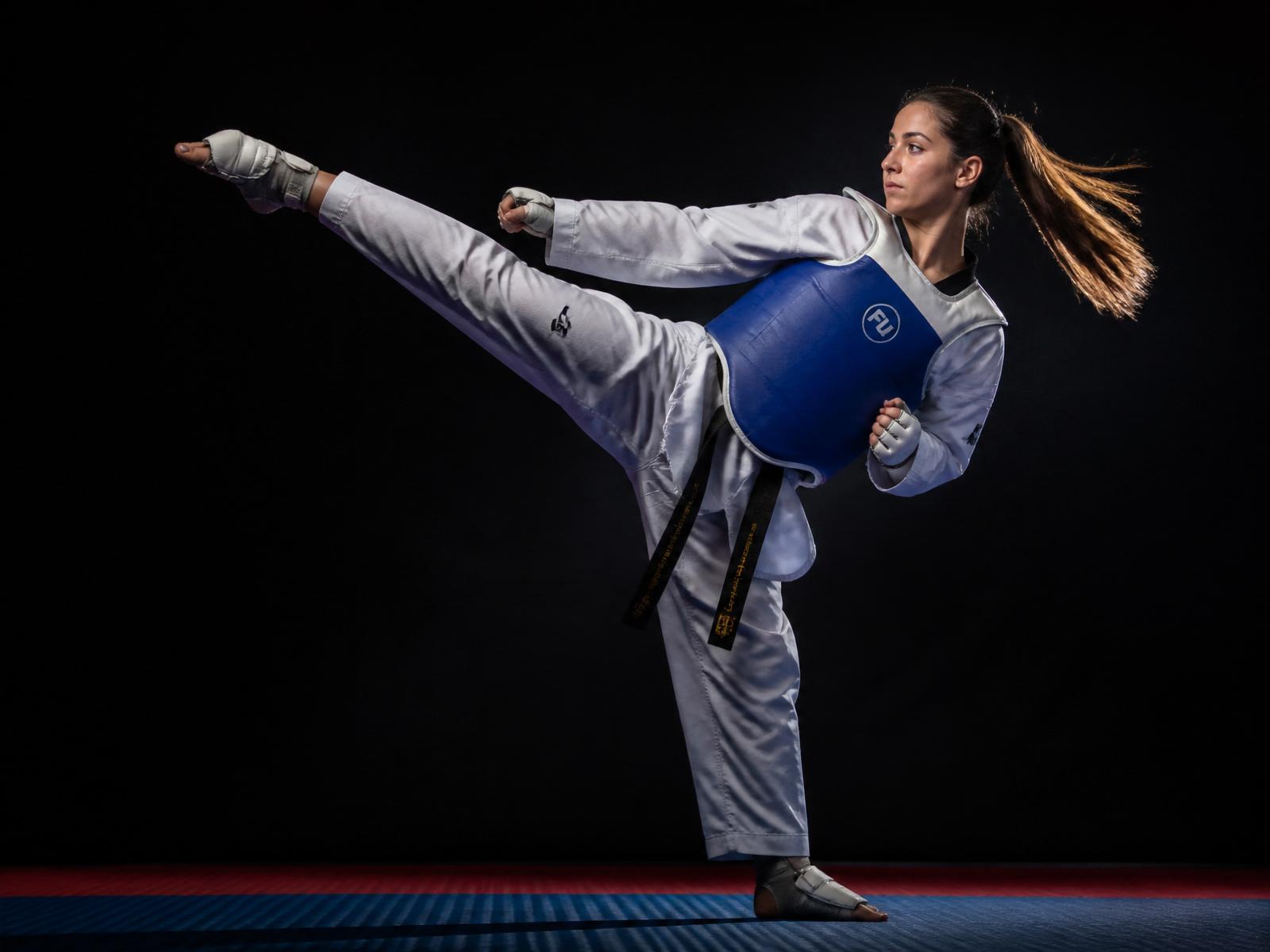
FU FIGHT covers the core of this list. Sensors in the protector detect valid hits and count the score, the data goes to the coach and athlete in real time through the app, and the coach can analyse precision, intensity and the split between punches and kicks. For attempts that do not land, a simple tally by an assistant or a video on a phone completes the picture.
From numbers to training decisions
Data is only useful if it changes what you do on Tuesday night. Use a simple rule: one observation, one decision.
| Observation | Possible cause | Training decision |
|---|---|---|
| Low precision, high volume | Rushed kicks, poor distance | Static accuracy drills, step in and score work |
| Good precision, low volume | Passive, waits to counter | Short rounds with a points target |
| Intensity falls in round three | Conditioning or pacing | Scored rounds after a fatigue block |
| No punches at all | Habit, lack of confidence up close | Clinch exits with punch then kick |
| No change over a month | Drill does not transfer | Change the drill, not the fighter |
Share the observation with the athlete in one sentence. Fighters accept a number more easily than an opinion, and they like having a target for the following week.
Mistakes to avoid
- Measuring everything. Pick two measures per fighter per training block. More than that and nobody looks at them.
- Comparing athletes of different categories. A light cadet and a heavy senior do not hit alike. Compare each fighter with their own past sessions.
- Changing the test. If round length, partner or drill changes every week, the numbers mean nothing. Keep one fixed format for measuring.
- Judging on one bad day. School exams, a cold, a hard week at work: look at the trend.
- Forgetting the eye. Data says what happened. It does not say why. Your observation and video still do that job.
- Turning training into a ranking. Publish personal progress, not a league table, especially with juniors.
A simple four week follow-up
Here is a format for a competition group. It contains no results, because yours will be your own. The point is the method.
Fixed test: at the same session each week, every fighter does three scored rounds against a partner of similar size and level. Same round length each time.
| Week | What you do | What you record |
|---|---|---|
| 1 | Run the fixed test with no instruction | Baseline for precision, intensity, punches versus kicks |
| 2 | Choose one priority per fighter and train it in two sessions | Same test, same measures |
| 3 | Keep the same priority, raise the difficulty (moving partner, fatigue) | Same test, same measures |
| 4 | Run the test, then sit down for two minutes with each fighter | Compare week 4 with week 1 |
At the end of week 4 you have three possible outcomes for each fighter:
- The measure improved. Keep the work in maintenance and pick the next priority.
- It did not move. Change the drill or look for another cause.
- It improved but something else dropped. This is normal. A fighter who focuses on precision may throw less for a while. Decide what matters most before the next event.
Write it down in a notebook or a spreadsheet. A line per fighter per week is enough.
Remember that FU FIGHT is a training system. Official competition uses systems recognised by World Taekwondo.
FAQ
How many sessions do I need before the data means something?
Three or four sessions with the same test format give a first trend. Before that, treat any change as noise.
Should athletes see their own data?
Yes, in most cases. With FU FIGHT the data reaches both coach and athlete in real time. Agree on one target with each fighter so the numbers stay useful.
Is this only for elite fighters?
No. A club squad benefits just as much, because the common faults (low precision, no punches, fading in the last round) are easy to spot and to train.
To see what the coach's view looks like, request the free documentation pack and the demo videos on the FU FIGHT site.
Ready to move to connected equipment?
Talk to our team about quotes, demos and partnerships.
Request a demo